Top Podcasts
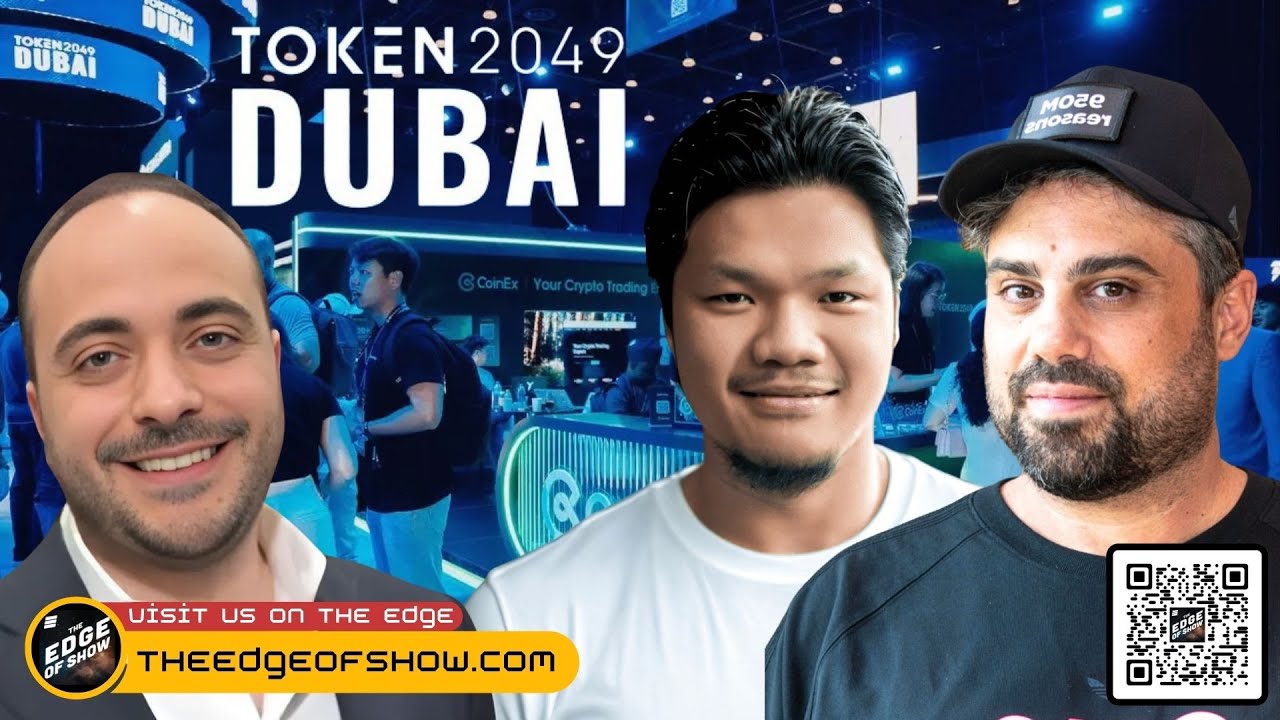
The Future of Digital Identity, DeFi and U.S. Crypto Market at Token2049 in Dubai
The Edge of Show dives into three cutting-edge ventures redefining blockchain user experience and adoption. Host Josh Kriger speaks with Marco Monaco, Co-Founder of TAC Protocol, which is seamlessly embedding Ethereum DeFi into Telegram’s super app ecosystem and Terrence Kwok, Founder of Humanity Protocol, tackling decentralized digital identity with zero-knowledge biometrics and also Richard Carthon interviews Vardan Khachatryan from FastX, a rapidly growing exchange now launching in the U.S. crypto market.
From biometric palm scans to silent DeFi infrastructure embedded inside your Telegram chats, this episode reveals how three builders are unlocking new paths for mass Web3 adoption. It’s not about speculation—it’s about real-world utility and onboarding the next billion users.
Key Topics Covered
-
**TAC Protocol’s DeFi + Telegram Vision **Marco breaks down how TAC Protocol is integrating advanced DeFi apps like Curve and Morpho into Telegram mini-apps, making crypto seamless for billions.
-
**Humanity Protocol’s Zero-Knowledge Palm ID **Terrence reveals how Humanity Protocol uses palm biometrics and zero-knowledge proofs to create verifiable, decentralized identities without storing raw data.
-
**FastX’s Dual-Exchange Infrastructure **Vardan discusses FastX’s expansion into the U.S. with completely separate infrastructure for compliance, highlighting their multi-product Layer 1 evolution.
-
**Stablecoins and Onboarding **Marco emphasizes how Telegram’s native wallet and stablecoin integration are lowering the barrier to entry into DeFi for non-technical users.
-
**Ticketing and Real-World Use Cases **Terrence explains how palm-based access will eliminate QR-based tickets, aiming to simplify event entry and reduce fraud.
Episode Highlights
-
“Our users don’t even know they’re using DeFi—and that’s the point.” — Marco Monaco
-
“Palm biometrics are less intrusive and already used in payment systems.” — Terrence Kwok
-
“The U.S. FastX exchange is fully separate to comply with all regulation.” — Vardan Khachatryan
-
“In five years, every piece of online content will need a signature.” — Terrence Kwok
-
“We onboard BTC, ETH, LSTs—TON becomes DeFi-native.” — Marco Monaco
Transcript: Richard Carthon: Hey everyone, Richard at Token2049, and we have Vardhan Katajan from FastX. I have been seeing you guys everywhere. I’ve had a lot of really awesome conversations, and one of the reasons I’m really excited to talk to you today is that FastX has actually come and launched its exchange over in the US. So I want to first talk a little bit about that, and then of course get back into your background and everything you have going on. So let’s just start with, I don’t know, how long have you been with FastX and what’s your experience been so far?
Vardan Khachatryan: So, it’s been already soon to be four years with FastX and it’s quite exciting because it’s a company that is growing and developing super rapidly in terms of products and in terms of the markets. And it’s quite exciting to be part of this journey, yes.
Richard Carthon: And it’s awesome because Fast Exchange is an exchange and it has been expanding quite rapidly globally. But of course now you are emphasizing and growing over in the West, over in the US. So tell us a little bit about the origin story of how FastX came about and why you’re choosing to specifically expand over to the US.
Vardan Khachatryan: So actually, the whole idea was generally to be as a token. So we started with that as an ERC20. And then we thought like, OK, we need to do an ICO, right? And then maybe we need to have some exchange offering. Oh, maybe we need an exchange. And then why don’t we have our own chain? Why do our token holders pay gas fees on Ethereum? Or why don’t we create a whole infrastructure on Layer 1, right? Right. And then, of course, we need a Layer 1 then. And then we went for the BAMUD and then NFTs were a thing back then. So we got into NFTs and marketplace. So, yeah, and it was just a long, interesting journey. And it keeps growing.
Richard Carthon: And I think it’s been really cool just to see how fast y’all been growing with all that. And with having that type of experience, it’s easier for you to also understand how to bring other chains and other coins on board because they’re having to go through a lot of the same experiences. And so you can empathize a lot with it and can speak to it. So as you’ve been onboarding and bringing on more chains to the platform, How is that? How would you describe that experience? So if someone’s listening to this, they’re like, yeah, I’m actually looking for a place to list. Like, what does that process typically look like?
Vardan Khachatryan: To be honest, we are quite selective in that regard in terms of coin listings. And one thing is like crucial to mention is that U.S. exchange and the international exchange are fully separated in terms of all the order books, in terms of wallets, everything. So there is nothing actually in common. The management is also separated. The approach in international exchange is a little bit more super selective, but more common. In the U.S. we are more strict because of U.S. requirements that are quite not that certain, I would say.
Richard Carthon: Yeah. OK, so with that, you know, choosing to come in and do it a little bit more strict regulation and having to put all of that in place. How has that process been going so far?
Vardan Khachatryan: Well, to be honest, we always wanted to get into the US market, because it’s the largest economy in the world and you don’t want to miss that. But the situation before this new government was quite… Let’s say unpredictable, uncertain, no clear rules, just regulation by enforcement. And that made us to definitely not consider U.S. market. But we were getting ready for an opportunity and the opportunity came, which was new approach towards crypto and, you know, virtual asset service providers. And that gave us the like, you know, perfect timing was for us to just launch a spot exchange.
Richard Carthon: Oh, agreed. And so, you know, with that, obviously, there’s some competitors that are already there, but you’re bringing a new way or you’re bringing new energy into how people in the U.S. are able to have these kind of experiences on chain, through exchanges, et cetera. So what would you say are some of your differentiating factors that people would be able to consider?
Vardan Khachatryan: I think it’s we bring some part of our ecosystem, meaning it’s going to be the same exchange again, but the experience is is the crucial part, right? I mean, if you are giving the right experience, then you have a competitive edge there, and that’s where we consider ourselves to try to be competitive there, yeah.
Richard Carthon: Yeah, and the user experience is really important. Being able to flow through and have everything work seamlessly is very important. So, obviously we’re here in Dubai, Token24.9, this is day one at the time of this recording. How’s the experience been out here so far, and why did FastX decide to be part of Token?
Vardan Khachatryan: It’s amazing because Socon is for generally like probably the biggest events in this space in Singapore and in Dubai. Last year it was a bit not the best timing because of the you know rains and stuff but this year it looks great. a lot of like almost everybody is here and from the players from the biggest to some small ones startups which is great so and FastX is a company that tries to be you know in the heart of the overall crypto ecosystem yeah and we are always attending at this big event so this is another one for us For sure.
Richard Carthon: And for those who aren’t here, unfortunately, the FastX booth is really awesome. Even have a little barista there. Somebody wants to, you know, get something to drink and you have a really big team there, which has been awesome. And everyone’s been very lovely to work with. So congrats on having an awesome team. But above all, man, so as you kind of just look at the roadmap for the rest of 2025, what does that look like for FastX?
Vardan Khachatryan: We are thinking of targeting the Brazilian market. We are working on that now. We are also getting ready for the new regulatory frameworks that are going to be in force. Brazil is a big market for us, it’s important. Expanding in Latin America at the same time, rather than Brazil. And probably having new products also, maybe in the real world asset organization and space and stuff.
Richard Carthon: Awesome. Well, they’re definitely growing fast. Actually, we should connect after. I know someone who’s doing some events out in Brazil, so I have to do that. But I appreciate you spending time with us. For those who want to learn more about Fastex, where can they go?
Vardan Khachatryan: Just if you’re a non-U.S. customer, then Fastex.com. And if you’re a U.S. user, Fastexus.com.
Richard Carthon: Awesome. Well, thank you so much for spending time with us, man. Thank you. My pleasure. Thanks for having me.
Josh Kriger: Hi everyone, Josh Krueger, co-host of The Edge of Show, live in Token 2049. In 2025, first guest today is Terrence Kwok, who’s the founder and CEO of Humanity of Protocol. It’s great to finally have you on the show.
Terrence Kwok: Thank you.
Josh Kriger: So for those that don’t know Humanity of Protocol and what Terrence is building with a great team, it’s a groundbreaking web-free identity platform using non-invasive Hanbai metrics and zero-knowledge proofs. He’s a visionary entrepreneur from Hong Kong, and he previously founded one of Asia’s first unicorns, is now focused on reshaping how we think about identity. Is that about right?
Terrence Kwok: Sounds good. What brings you to Token24.9 Dubai? I mean, the energy is great. I was here last year. I’m giving a keynote tomorrow. I love Dubai, right? And then I think Dubai last year for a lot of people was a little bit bizarre with the rains and the floods. Tell me about it. But to be frank, I don’t know whether I prefer the floods or the heat. It’s hard to decide.
Josh Kriger: It’s amazing how two or three weeks makes such a difference on the thermometer. What’s your keynote about?
Terrence Kwok: date and identity. Right. And I think for us, it’s not a very hot topic yet, but I think it will be should be. And it’s it’s it’s very it’s I think it’s a very important problem that we’re we’re trying to solve.
Josh Kriger: The analogy that I remember someone sharing with me that really stuck in is like you go to a bar, you you have to show your ID, but but you’re showing a lot more information than what is actually necessary to verify you should get into the bar.
Terrence Kwok: Yes. So yeah, I mean, the problem is if you show your driver’s license and depending on the state, you’re showing their full name, their address, all sorts of pieces of information that’s not necessary. Technically, all you really need to show is a true or false statement of whether you’re over 21 or not. And I think in the Internet and in the Internet world, or even in the Web3 world, it’s sort of a similar concept. I think for us, it’s using zero-knowledge proofs to make sure that we’re only showing the pieces of information that we want to show, we need to show. You know, how we think about this is looking at different sort of attributes about a person. And one of the key things that we’re obviously starting with is where we come up with humanity. If you look at it a couple of years ago, it’s saying to somebody, hey, you know what? You need to prove that you’re a human. That probably doesn’t sound very logical. Totally. But in the last six months, I think a lot more people would be like, yeah, this is critical. Yes. I think in the last year and a half, people realized, OK, you know what? At least in the online world now, content, it’s not discernible. Right. You know, tragedy generated. In fact, you can almost argue, hey, you know what? If it’s too well written, it’s probably AI. You look at sort of video content, you have like your deep fakes, you know, it’s not the sort of at this point. And then voice generation, all that sort of stuff. So, you know, in the online world, we actually think it’s becoming very important to be able to verify whether something is, you know, human or AI generated. And then I actually think this, maybe down the future, you know, you look at all these like humanoids and robots and all that sort of stuff. Maybe like, you know, we’ll eventually get to a place where it’s almost like a Westworld, you know, the TV show where like, you know, you need physical, in the physical space, we need to discern whether somebody’s human or not.
Josh Kriger: You got me thinking about something because like, you know, people ask, like, what’s the future of media? If you can have sort of like, Tim Kraper has a digital twin that’s doing those updates on his portfolio. But I think AI is getting so sophisticated that it could add the ahs and ums into the conversation and even make like the mistakes feel more authentic. I think there’s no telling where AI can go in terms of its replication of a human-like context, experience, conversation, dialogue. So this is a sort of critical piece. So maybe break down the technology stack a little bit more and how you all are doing this in a unique way that you think is sustainable, replicable, powerful enough to become a standard that can be used and adopted globally.
Terrence Kwok: So ultimately, you know, what we’re we’re building is a blockchain focused on data. And I get it right. And the the sort of mechanism we’re using is a verified. And so it’s not really just the the biometric space, it’s everything. Right. Like it might be potentially a reusable national ID credential. It might be like a proof of education credential, proof of employment credential. And then, you know, we’re now building stuff out with ZKTLS so that it’s potentially even proving your airline loyalty status or any sort of thing that somebody might want to prove, right? And then on the humanity piece, what we’re starting off with is biometrics, you know, and, you know, the biometrics that we’ve decided to go with is the person’s palm. So everybody’s palm, whether it’s the palm prints or the palm veins are completely unique. And what we’re doing is both via software as well as hardware, registering people, encrypting that, never storing any sort of law data, comparing the signatures, and being able to determine whether it should move or not. Why didn’t you choose palms versus eyeballs? I think there are two things, right? Number one is that the iris is, there are a lot of parts, a lot of body parts that are completely unique, right? So when you think about the fingerprint, you think about your palm print, you think about what your iris is, these are all sort of the biometrics. We decided to go with the palm because I think ultimately it’s slightly less intrusive. It’s probably a lot less intrusive to most people. And then I think the other thing that’s also important is, you know, we think there’s going to be a lot more use cases, right? So we look at sort of Hong based by metrics, obviously in the U.S., Amazon. And in China, Tencent is already using this for payments, right? And Amazon, you know, there are a lot of people who are using cloud-based payments for Whole Foods. Tencent is doing that with WeChat Pay, right? So there are use cases where, you know, whether it’s payment or maybe it’s ticketing, just now I had to come up and it took me like 5-10 minutes because I had to search for my ticketing email and then I had to check my ID, all that sort of stuff. Whereas, you know, we are also now actually starting to, this year we’ll be starting to work with a lot of events where, you know, if you have a human ID and that’s registered, when you buy a ticket to an event, you can just type in your human ID and then your palm is already, you know, your palm’s already registered, you can easily just access your ticket directly through that, right? So it’s a lot more, it’s a lot more accessible and easy to use than, you know, you would never go scan your iris to pay for a coffee, so.
Josh Kriger: And I guess, like, is there this duality for a while, like, with any kind of new approach to paying for things or showing, like, some people may go and not have their palm scanned yet, and they may be in an experience where, you know, now they need to. So are you thinking about, like, onboarding as part of sort of the adoption curve with where you have this duality in terms of access?
Terrence Kwok: Yeah. Well, absolutely. Right. Like, so that’s why we need to find use cases. So I think, I think a little bit unlike some of the other projects that are in this space, our goal is not like, our goal is not to focus on UBI or like to pay people to come on for, for, you know, to scan their biometrics. Right. Like the, the goal for us is to have that utility from day one. And so it’s, it’s also about like finding various use cases that we can implement this.
Josh Kriger: But like Apple Pay, I mean, all of a sudden I’m using Apple Pay because it was the most convenient option because there are so many ways I can use it. Yeah. Right. So I was like, oh, I was a late adopter. And then I was like, oh, wow, this is the easiest thing ever. Sure. You know?
Terrence Kwok: Yeah. So I think for us, it’s it’s like finding certain niches. I think, you know, one of the first niches that I mentioned is where we’re going to do is is really on the ticketing side. Right. And because if you go downstairs, you see how long a line is. Right.
Josh Kriger: One of your tweets said, Capital isn’t always a signal. Do you remember that tweet? Maybe you could talk to us about what’s behind it?
Terrence Kwok: You know, I think that the the when we look at I think I mean it in a couple of ways. Number one is that on the on the when I look at sort of the whole VC space and crypto, right? Like I think sometimes it’s narrative after narrative after narrative. Right. So people are chasing like hot narratives. I think for a while it was like defunds and then, you know, and then it became like agents. And then, you know, like. I feel like, whereas if you look at, call it like Web 2 or traditional tech indeed, where my background was from, generally, you know, companies or projects decide that they want to do one thing and then they spend a decent amount of time to focus on building that thing. Right. And so I think, you know, for us, that’s something that we we’re trying to do because we believe this has long term value rather than necessarily saying, let’s chase whatever It’s hot for the moment for all, you know, for Veteran Apple.
Josh Kriger: I, you know, it sounds like, you know, Post-Oscar Zambop or Filecoin, you know, they’ve been building for a long time. They’re still building. They’re sticking to their mission. They’re expanding it. They’re evolving with the times. Yeah. But I look at what they’re doing as much more of a web to come down there. Absolutely. Right. Absolutely. So, you know, you got to face sustainable communities. You mentioned some of the stuff you’ve grown on, any other major announcements, partnerships brewing that you can speak to?
Terrence Kwok: There are a lot of partnerships. And then on top of that, we’re upgrading our testnet very soon, like literally next week or something. And then we’re planning for mainnet, building out sort of a bunch of different partnerships, projects. And I think more importantly, we’re also going to be rolling out the hardware devices and then also launching the app for people to sort of pre-enroll directly on their smartphones. And then afterwards through, you know, registration for physical locations.
Josh Kriger: said and stuff. So let’s fast forward. I think we’re all futurists these days, or pretend to be. You know, you’ve got your technology built out, maintenance launch, the ticketing’s done. Where do you see Humanity Protocol going in the next three to five years? What does the world of decentralized privacy look like at that point?
Marco Monaco: Not bad, not bad, yeah.
Marco Monaco: Oh, many things.
Josh Kriger: It’s just the human side.
Marco Monaco: Thank you very much, Josh.
People and Resources Mentioned
About Our Guests
Marco Monaco is the Co-Founder and Growth Lead at TAC Protocol, a Layer 1 blockchain bridging Ethereum-based DeFi directly into Telegram. Formerly at Linea (ConsenSys’ ZK-EVM), he helped onboard half a million users and built $1.3B in TVL. Now, Marco’s redefining crypto UX by fusing chat-based apps with complex financial infrastructure.
LinkedIn: Not available Website: TAC Protocol Twitter: @MarcoMonaco83
Terrence Kwok is the Founder and CEO of Humanity Protocol, a zero-knowledge biometric identity layer prioritizing privacy and real-world utility. Based in Hong Kong, Terrence previously founded one of Asia’s first unicorns and now focuses on decentralized digital identity using palm biometrics.
Vardan Khachatryan is the Strategic Director at FastX, overseeing global expansion and regulatory infrastructure. With nearly four years at the company, he has helped scale the project from token to multi-product Layer 1 blockchain and exchange, now live in both global and U.S. markets.
LinkedIn: Not available Website: fastex.com Twitter: Not found