Top Podcasts
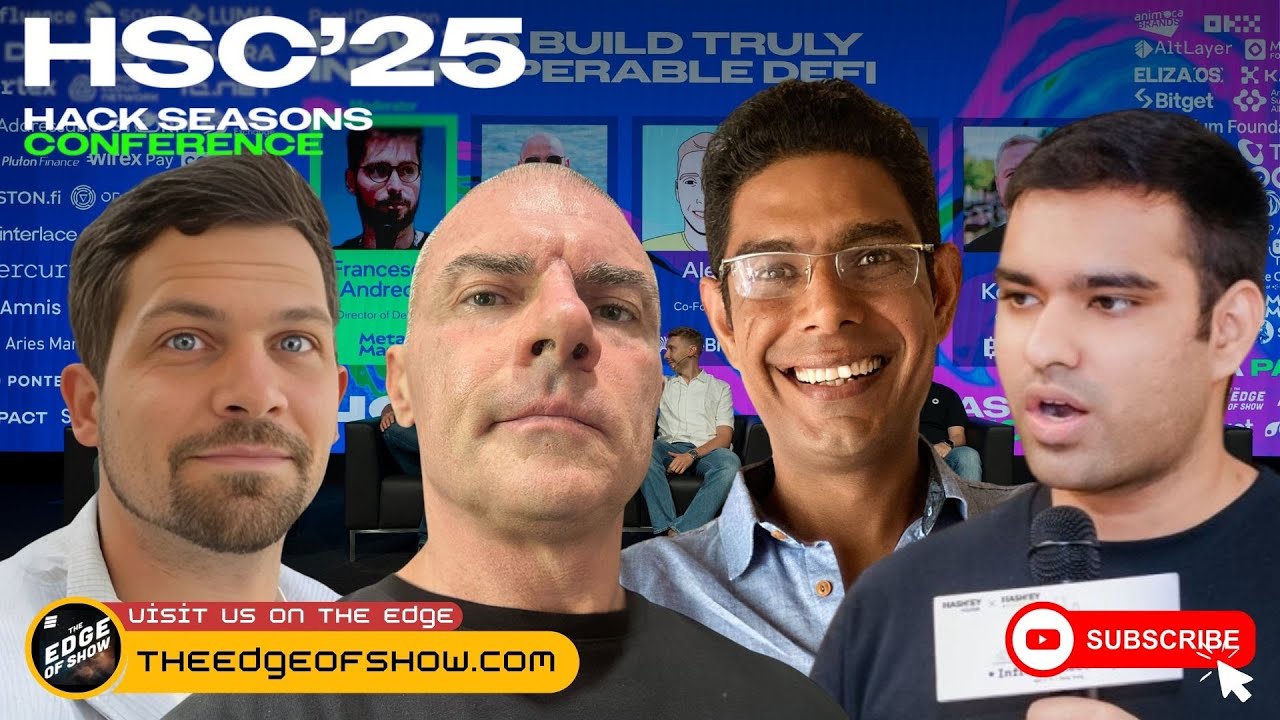
How Emerging Technologies are Shaping the Future of Finance and Communication at Hack Seasons 2025
“The Edge of Show” dives into the bleeding edge of Web3 infrastructure innovation. Co-host Josh Kriger brings you inside conversations with visionaries shaping the next generation of blockchain technology, including Jon Jones of Supra, Rachit Agarwal from Wormhole, Igor Lessio of Eliza, and Gaurav Sharma of io.net. From native oracles and system-level automation to cross-chain communication and AI-enabled agent tooling, this episode unpacks how these tech leaders are redefining scalability, security, and speed in decentralized environments. For crypto developers, institutional investors, and builders exploring high-throughput chains and real-world blockchain integrations, this is your roadmap to what’s actually happening on the ground—and what’s next.
Key Topics Covered:
-
Supra’s Native Oracle Integration: Jon Jones discusses how Supra’s fully vertically integrated L1 differs from modular approaches by embedding oracles and automation at the system level for lower latency and better execution in DeFi.
-
Automation via “Autofy”: Supra’s launch of Autofy introduces automated smart contract logic using AI—bringing a new level of user accessibility for automated DeFi strategies directly into the protocol.
-
Cross-Chain Comms & Supernova: Supra’s Supernova enables native cross-chain communication, facilitating unified execution layers for developers and users working across different virtual machines.
-
Wormhole’s Institutional Bridge Strategy: Rachit Agarwal explains Wormhole’s pivotal role in tokenizing funds from BlackRock and Apollo, emphasizing value accrual, regional growth in APAC, and multi-chain messaging.
-
Eliza’s AI Agent Swarm Systems: Igor Lessio showcases Eliza’s open-source AI agent platform with modular plugin support and mobile-first user interaction, aimed at empowering solo builders with smart assistants.
-
io.net’s GPU Aggregation Model: Gaurav Sharma illustrates how io.net is democratizing compute access by aggregating unused GPU power from gamers, data centers, and idle machines—driving down AI costs for startups.
Episode Highlights:
“We’re the opposite of modular. Supra embeds oracles, price feeds, and automation at the system level.” — Jon Jones
“If your automation logic has latency, you risk MEB attacks—integrating it into L1 is crucial.” — Jon Jones
“APAC is buzzing. The moment we mentioned BlackRock and Apollo tokenization, the credibility clicked.” — Rachit Agarwal
“I built an agent that creates data for my other agents while I’m at the beach.” — Igor Lessio
“AI companies spend up to 50% of their capital on compute. We cut that by 70%.” — Gaurav Sharma
Transcript:
Josh Kriger: Hi, everyone. Josh Krueger, co-host of The Edge of Show, live at Hack Season in Dubai. It’s a bustling week. I’m here with John Jones, the CBO and co-founder of Supra. Good to have you on the show, John. Thanks, Josh. Always great. Yeah, yeah. So it’s been a minute. Catch us up on what’s going on with Supra, of course. But just for background information, those that don’t know, what is Supra all about? There’s a lot of L1s out there. I think over 75 now. What makes Supra different?
Jon Jones : Sure. So Supra, we went to market as an Oracle years ago, but Supra is actually a fully vertically integrated L1 with native Oracle. So we have built-in system level Oracle, like for example, price feeds, automation, as well as cross-chain communications. And I can talk about why that makes sense, but we’re like, We’re the polar opposite of the modular world and thesis where we are fully vertically integrating these stack of Oracle services to make better applications on Super. Specifically, we’re spearheading DeFi in the beginning and we’re focusing on what we call execution quality.
Josh Kriger: and will have better execution quality when you vertically integrate Oracle services at a system level on the L1 at C. Yeah, so I guess that’s like counter thesis to the idea of modularity and sort of giving folks more flexibility with what they need and what they don’t need. Does this all-in-one solution service a particular segment of the population, or is it just one of those things where everyone can benefit from it, it’s just what do you choose to use?
Jon Jones : Sure. I would say, first and foremost, a lot of these high-throughput chains, including Supra, Apto, Sui, are all-purpose chains. But when you think about it, blockchain is all about the transfer of value. And so from Supra’s perspective, we’re really trying to spearhead DeFi first. We think that if you can do DeFi well, and you can focus on having the best execution in DeFi, there are other models and other applications that can now also build on Supra that can benefit from the same execution quality and performance for DeFi.
Josh Kriger: It makes a lot of sense. And now you have, I guess, one of your exciting new initiatives is automating some of the stacks. Talk to us a little bit about that.
Jon Jones : Yeah, so that’s called Autofy. So it’s a new term. Of course, you have automation, DeFi, you combine it, it’s Autofy. Something new to add to our crypto lexicon. Yes, and hopefully this becomes something that is ubiquitous. You heard it here first, Autofy. OK, what’s that all about? So automation is something that traditionally is in the blockchain space. You have external protocols like Chainlink or Gelato that can do automated services and automation is basically if this then that. So you create conditional logic and that’s really powerful for blockchains. Are you using AI to assist with this? Yes, I’ll get to that later. And that’s interesting because being able to use your intent, like I want to do something and have AI craft and automation, that’s actually where retail I think will benefit and use this the most. But what Supra does is we use automation at the system level. So our validators are not only running consensus on transactions, but they’re also performing these automated tasks. So you can imagine that if you have one unified system that is ordering blocks, creating a transaction, seeing Oracle data, but also automating a task, it can be done with very low latency. So that alludes to the fact that we have great execution quality. Whereas if you use an external protocol to get that data, there’s latency there. Every external protocol you use, you’re adding latency and worse execution quality. And why would users care? Well, if you have bad execution quality, you have latency. Someone could, what we call MEB, right? They can MEB you, sandwich attack. Like I think a lot of, like some people in Web3, a lot of people on X might have heard that this guy was transferring like $250,000 in E. And he only got like 12,000 in value because someone front ran his transaction and he lost a lot of value. And that’s like an example of bad execution quality. And that happens with added latency. And when other, you know, traders see what you’re doing, you know, and see what you want to do, and they basically take advantage of you. So you can have better execution quality when you kind of integrate that into one stack.
Josh Kriger: Nice. So the potential for front-running is heavily mitigated? It is, yeah. Cool. That’s exciting. Well, congrats on that. And I guess anything else on the roadmap that you want to make sure we cover?
Jon Jones : Well, so automation is going live on Testnet today. So we’ve been live on our mainnet. We were the third Movebase L1, like after Aptos and Sui, and Movelang and MoveVM to go to mainnet. That was in November. But now, six months later, we have the biggest testnet upgrade since our token generation event, and that’s having automation live on testnet. So automation and also our cross-chain communication protocol called Supernova, that together is just really huge. And so we have already a lot of teams that are starting to test and build it out. But I’m really excited to see the things that they built. One thing, and you did talk about AI, right? And how that might kind of interact with automation, is that we have one project called Dexlin who built this chatbot where you can basically craft a strategy. Like, let’s just say I want… hey, I want to be able to, if Bitcoin goes below this price and sentiment analysis is here, I wanna be able to put 50% of my assets into stables and I wanna automate this. And you basically speak your intent to AI and then the AI will then craft using blockchain and logic, will craft your automation and you can decide to hit yes Or you can then speak and say, no, I actually want it a little bit different. But this allows the general user to use these automated tasks that traditionally have been used only by high frequency trading firms, you know, to actually code this login.
Josh Kriger: Well, so it’s right. It’s basically built into L1. You don’t need a separate DAP for that. That’s right. Very cool. So. I guess what is the sort of volume of trading where super is at right now and what what coins can folks access through super and for your broader ecosystem? What are you integrated with? What are you looking to integrate with next?
Jon Jones : Yeah, so first of all, like, so we launched six months ago, and our defy ecosystem is really booming. I don’t necessarily I did say one name, I don’t want to do some too many name drops at the moment. But we started with Move, Move VM. And we were kind of limited to the amount of builders and apps that actually build in the Move ecosystem. That’s AptoSuite, now Supra. But we got like about 20, 30 teams to actually commit to build, which is awesome. But we have a whole backlog. of like 100 plus MOUs of companies and builders that want to build on the EVM on Supra. So we’re, you know, in the next, you know, little while, soon, we also have EVM, Ethereum Virtual Machine, also live on our network. So on one shared security validator set, we’ll allow different virtual machines. So move first and then EVM will be on testnet shortly. So that’s when things get really exciting because there’s a whole new group of developers and teams that want to deploy specific DeFi protocol on Supra or a DeFi protocol that’s already multi-chain or NFT marketplaces that want to integrate with Supra, but maybe they want the EVM integration and not the move integration. So we’re giving developers a lot more access to deploy onto Supra without, you know, it’s very developer friendly to be able to support many VNs.
Josh Kriger: That’s exciting, man. Well, appreciate the update. Always great to see you. If folks want to learn more about Supra, maybe follow you guys on XFOLU. Where do they go?
Jon Jones : Yeah, yeah. Well, Supra underscore labs on X. And you can follow me, John Evans Jones. That’s J.O.N. Evans. I’m sorry, I’m not a part of the Josh Club.
Josh Kriger: No, and you’re not a UFC fighter, but that’s OK. Yeah, but I do have the John Jones. All right. The other John Jones, the John Jones of Web3. You heard it here. Good to have you in the show.
SPEAKER_06: What’s up, everybody?
Richard Carthon: Richard Carthon here from the Edge of Show live here at Hack Seasons. And I just got off a really awesome panel with Rajit. We talked about decentralization and why it’s important and what’s going to be happening next. But we had such a good conversation. He gave such great responses. I was like, man, we have to have a further conversation. Make sure that the world knows more about what you’re doing over at Wormhole. So tell us a little bit about yourself and a little bit about Wormhole.
Rachit Agarwal: I appreciate it. It was a great panel and a lot of fun. So, you know, Wormhole is an interoperability platform. Those are many complex words. Let me try to break that down for you. So think about it in a way where there’s so many different chains, right? Like you have Ethereum, Solana, Base, Arbitrum. From a user perspective, how do you move funds from one place to another? That’s where Wormhole comes in and Wormhole technology comes in, where you can transfer assets from one place to another. That’s probably the most basic use case for Wormhole. Over the years, we’ve built up tech stack to support developers as well. A very simple, basic instance of this is messaging. So if you’re on one chain and you want to go to another chain, you need to make sure that both of those protocols or those instances are communicating with each other. So that’s one of the things that we’ve built. Fun fact, Worm was actually the first bridge from Solana to Ethereum. And that’s sort of the backstory and how we’ve grown over the years. On me, I’m the APAC lead at the foundation. I joined about five months ago. I used to work at a marketing agency before that. I was leading the growth team. And I started off in crypto in the VC scene. So I’ve been around.
Richard Carthon: You have, man. So a well-rounded background and being able to be the very first bridge from Solana to Ethereum obviously is a very big bridge. But I want to lean more into what you’re doing in the APAC. So as you’re seeing opportunities that are happening in this space, there’s been a lot of emphasis in the APAC region. So what’s happening over there and why are you strategically focused on that specific region?
Rachit Agarwal: The world out there is wild. You’re based in the States? I am. Like, if you ever go to Hong Kong, the crypto scene is so different. Like, OK, so one of the basic differences that I recognize is, you know, in the States or in India as well, like people love to back things that are doing multiple things like, OK, this thing’s doing four different narratives and they fit into everything. In Hong Kong or in like APAC, they want to focus on one thing. So in Hong Kong, what I realized was they recognized Wormhole with Interop. And they actually understand what Interop is, which was pretty surprising to me because, you know, like with the Indian accent, it’s really hard to say interoperability. So I thought, you know, it would be really hard, but they actually get it. So what we’re doing right now is since we’re like in this post TGE phase, Wormhole is an interesting part because we have a ton of users. What we realized in APAC is a problem for a lot of other protocols as well is our communication rails there are not very strong. We focus a lot on Twitter. We have really strong Western comms and English comms, but our Chinese comms, for instance, or our Korean comms or our Vietnamese comms, not up there. We’ve naturally had a community that’s really engaged in all these countries. My primary job is to focus on each region individually. Each region will have a different focus as well. You really create incentive structures, community structures, and communication structures so that Wormhole’s mission is then portrayed effectively to these things or these community members.
Richard Carthon: I really like that, like it’s really important the communication and how it is presented and bridging those gaps and understanding and even like what could make sense in the West may not translate over into the East and everything else that’s going. So as you’re kind of bridging that gap from a communication standpoint and from a focus standpoint, what’s the messaging kind of been like so far?
Rachit Agarwal: Yeah, love the puns by the way, love you using bridging like four times, that sentence. But basically, okay, so Wormhole recently started working with Securitize, well not so recently, we’ve been working with them for a while, but they recently tokenized the BlackRock fund and we helped them go multi-chain on that fund. Similarly, Apollo Credit, also a big institution, big private credit enabler, they also came on chain with Securitize and we helped them go multi-chain with our technology. That’s been a really big narrative focus for these APAC countries. They instantly hear BlackRock, Apollo, they instantly associate credibility. So the crypto credibility problem is now starting to solve with these bigger institutions coming up. where family offices in Hong Kong are like, okay, if BlackRock’s tokenizing their fund, maybe I should be thinking about it. And that’s the shift that we’re slowly seeing in APAC, where the Western legitimacy of like these bigger institutions is coming here. And then Hong Kong government is also pushing forward for that. They’re actually going to launch their own stable coin as well. So you’ll see a lot of development come out, but it’s always been a reputation and credibility thing. I think that’s going away. And, you know, platforms like Wormhole are trying to portray that message forward.
Richard Carthon: I think it’s awesome that you’re seeing so many of the institutional players, whether it be banking, whether it be these big financial institutions who are embracing and being like, hey, no, we’re going in on crypto. We’re really embracing this. The fact that you’re trying to create like Hong Kong’s creating stable points and these on and off ramps for people who are trying to enter this space, I think is very impressive. And obviously, Wormhole has been doing that a lot for not just people within the crypto space, but for those who are coming in and trying to go cross chain. More generally, outside of what’s happening in the APAC, when you look at what Wormhole is doing at the time they’re supporting it, it’s 2025. Over the rest of this year, what are some of the things that Wormhole is focusing on?
Rachit Agarwal: For sure. One of the bigger narratives that we’re focusing on this year, and this is something that Dan, our co-founder, mentioned in one of his blogs recently, we’re thinking about activating P-Switch. And we’re thinking a lot about value accrual to the Wormhole protocol. That’s one of the focuses. But if I talk about the overall vision, the 10, 20-year vision for Wormhole, we really want to get into this institution narrative. That’s the number one focus for us. We’re working with BlackRock. We’re working with Apollo Credit. We’re working with Securitize really closely. We see a lot of the banks, also we recently announced with Mercado Bitcoin, it’s like the biggest exchange in Brazil. So crypto is making its rounds around the world. And we’re most definitely going to make rounds alongside with it. So the FeeSwitch side, definitely interesting for our community members, the institutional side, interesting for everyone else.
Richard Carthon: So with emphasis going more into the institutional piece, for someone who’s listening to this, they’re like, hey, actually, I’m trying to break into that space as well. And it sounds like Wormhole could be a great way to potentially help to get into that. So how are these kind of like partnerships and alignments with institutions being facilitated?
Rachit Agarwal: Yes. So. Technically, it’s very simple. We have this entity, it’s called Native Token Transfer. It’s like a pretty simple UI. You and I could launch a token and go multi-chain in like 10 minutes. But for institutions, they need a lot more credibility than that, right? So for them, the first thing that they want to figure out is, What chain should I go on first? All right. Traditionally, it’s been Ethereum. We’re seeing a lot more conversations where people want to come on Solana and do a lot more of those things. But the first thing that institutions need to worry about is what chain are you actually going on? After you focus on that, that’s where a partner like Wormhole comes in where, OK, you’ve built a base, you’ve built a home, and then you can go to 10, 15, 20 different chains. The biggest unlock for a you know, like a platform like Wormhole to work with an institution is that liquidity is really fragmented in crypto. And as an institution, why do you want to be married to one chain when you can get liquidity from every blockchain? Right. So it is still recommended for an institution to think about one blockchain first, test the rails, understand what’s going on, work with a partner like Wormhole or the Gereon Foundation or the Solana Foundation. get into it, you know, understand how it helps the 24-7 market thing is something that institutions like it’s been mind-blowing for them, like how crypto is 24-7. Stress for them. But yeah, pick your base and then think about multi-chain. Think about how you can access liquidity to your products.
Igor Lessio : It was very fast.
Josh Kriger: Your friend, your concierge.
Josh Kriger: So is the token to use the product?
Josh Kriger: Exciting stuff, my friend.
Josh Kriger: More and more than ever before.
People and Resources Mentioned:
About Our Guests:
Rachit Agarwal serves as APAC Lead at Wormhole Foundation. Formerly in VC and marketing, Rachit is helping shape Wormhole’s multi-chain messaging protocols and institutional adoption strategies, especially in high-growth regions like Hong Kong, Korea, and Vietnam.
Gaurav Sharma is the CEO of io.net and a former Binance executive with experience at Amazon and eBay. He’s leading the charge to decentralize compute infrastructure, bringing idle GPU power into AI workloads via a scalable, Web3-native architecture.
Guest Contact Info:
Jon Jones (Supra)
Rachit Agarwal (Wormhole)
Igor Lessio (Eliza)
Gaurav Sharma (io.net)