Top Podcasts
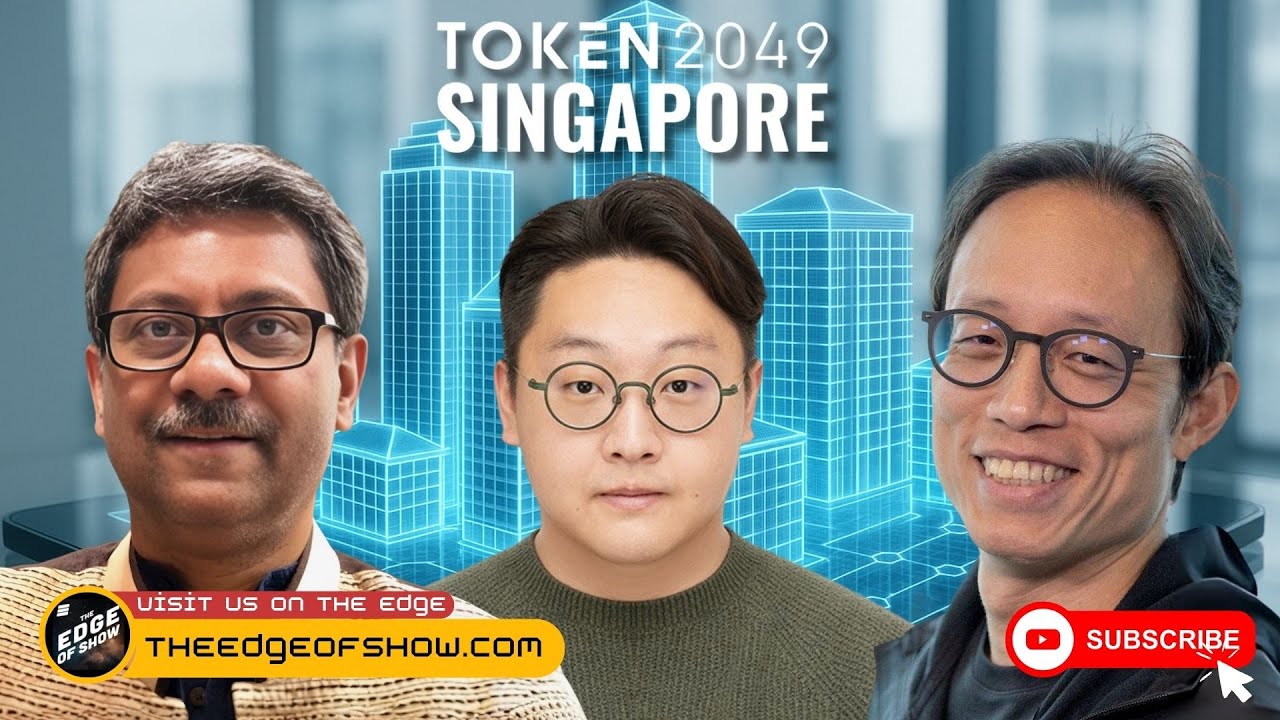
Building the Metaverse: How Gaming and Blockchain are Reshaping Digital Economies
At Token 2049 Singapore, The Edge of Show dives into how crypto’s next cycle is being built in real time. Host Josh Kriger sits down with Yat Siu (Chairman, Animoca Brands), Alok K. Sinha (Co-Founder & Chief Ecosystem Officer, Puzzle Labs VEI), and Keith Kim (COO, Nextbase / MapleStory Universe) to unpack the future of real world assets (RWAs), altcoins, and Web3 gaming.
From tokenized real estate and on-chain mortgage bonds to altcoin treasuries, digital asset trusts and MapleStory’s Web3-powered metagame, this Token 2049 Singapore special shows how capital, culture and IP are converging. If you care about where crypto is actually going—beyond memes and market cycles—this Token 2049 Singapore conversation gives you concrete examples, playbooks and mental models straight from operators who are already shipping.
Key Topics Covered
Why Token 2049 Singapore feels like “Internet 1995” for tokenization
Yat Siu explains how growing regulatory clarity and institutional adoption have opened the floodgates for tokenization. From Bitcoin ETFs to digital asset treasury companies, Token 2049 Singapore marks the moment when tokens become a long-term structural part of global markets, not just a speculative side-show.
Crypto adoption, capitalism and why emerging markets move first
Using examples from Ukraine, India, South Korea, South America and hyperinflation cases like Zimbabwe, Yat breaks down why regions that need capitalism and property rights most are often the fastest to adopt crypto—framing Token 2049 Singapore as part of a much larger geopolitical and economic realignment.
Real world assets and tokenized real estate at global scale
Alok K. Sinha shares how Puzzle Labs is taking traditional U.S. mortgage flows and global commercial real estate and putting them fully on-chain. From NFT-represented loans to ERC-3643 RWA bond tokens and an 80-story mixed-use tower in Bahrain, this Token 2049 Singapore conversation shows RWAs moving from theory to production.
Structuring RWA bonds, yields and risk in DeFi-native language
The episode dives into how Puzzle Labs structures AAA vs BB tranches, uses pool NFTs to lock loans, and targets yields from high single digits to mid-teens while still respecting real-world credit risk. For DeFi listeners, Token 2049 Singapore becomes a masterclass in how TradFi securitization logic meets on-chain liquidity.
Hedging BTC with tokenized real estate and on-chain credit
One of the most compelling Token 2049 Singapore segments covers a hedge fund strategy where BTC is deposited, loans are issued at conservative LTVs, and proceeds are deployed into RWA tokens. By pairing volatile crypto collateral with tokenized credit and property, the structure aims to reduce liquidation risk while keeping upside.
Altcoins as a new “utility index” for global innovation
Yat reframes altcoins as the true engine of innovation—more like the S&P 500 of crypto than just speculative side bets. Instead of hunting for a single “altcoin to flip Bitcoin,” he argues that thousands of utility-driven altcoins will collectively surpass Bitcoin’s market cap while Bitcoin remains crypto’s savings account—an idea that lands powerfully in the Token 2049 Singapore context.
MapleStory Universe and Metaplay: Web2 gaming meets Web3 rails
Keith Kim unpacks how Nextbase and MapleStory Universe are using blockchain to supercharge “Metaplay”—the layer of trading, upgrading and meta-strategy around the core game loop. At Token 2049 Singapore, he explains how Web3 lets builders, not just studios, create new meta-experiences and earn from them.
Stablecoins, builder-first economies and mobile-native gaming
Keith explores when stablecoins make sense in games, how on-chain assets unlock new investor bases and builder incentives, and why the future is a hybrid of PC-grade depth with mobile meta-layers. In the Token 2049 Singapore ecosystem, MapleStory Universe becomes a blueprint for legacy IP evolving into fully on-chain, multi-platform economies.
Episode Highlights
“Tokenization is no longer a thought experiment. Institutions see other public companies holding tokens and realize this is a long-term structural shift.” – Yat Siu
“If you originate mortgages on-chain, data and documents are immutable. What used to take four or five months to become a bond can compress to under a month.” – Alok K. Sinha
“We represent each loan as an NFT, lock them into a pool NFT, and mint RWA bond tokens on top—mirroring any capital structure the market needs.” – Alok K. Sinha
“Everything you own in an IP—characters, items, progression—will be treated as an asset. Web3 just makes that obvious and tradable.” – Keith Kim
“Building a durable IP like MapleStory isn’t one secret trick. It’s making slightly better decisions than worse ones, over and over, for ten years.” – Keith Kim
People and Resources Mentioned
Yat Siu
– Chairman, Animoca Brands
Animoca Brands
– Web3 gaming and metaverse investment company
Alok K. Sinha
– Co-Founder & Chief Ecosystem Officer, Puzzle Labs VEI
Puzzle Labs
– RWA and on-chain securitization platform
Nuva Marketplace
– Joint RWA initiative mentioned alongside Animoca / Providence (context in episode)
Republic
– Investment platform exploring tokenized equity and RWAs
Solana
– High-performance blockchain referenced in cross-chain/RWA context
Dogecoin
– Meme coin referenced as a future potential treasury asset
MapleStory
– Original MMORPG IP from Nexon
MapleStory Universe
– Nexon’s Web3 expansion of MapleStory
Nexon
– Global gaming company behind MapleStory and MapleStory Universe
The Edge of Show
– Media ecosystem formerly known as Edge of NFT
(Some project names like Nuva marketplace and specific hedge funds are discussed conceptually in the episode and may not yet have standalone public sites.)
About our Guests
Yat Siu – Chairman, Animoca Brands
Yat Siu is the Co-Founder and Executive Chairman of Animoca Brands, one of the most active Web3 investors and operators in the world, with a portfolio of hundreds of projects across gaming, metaverse, infrastructure and decentralized finance. A long-time tech entrepreneur and early advocate for digital property rights, Yat helped drive mainstream awareness of NFTs and play-and-earn models while backing leading projects across chains. At Token 2049 Singapore, he shares how regulatory shifts, stablecoins and RWAs are converging to make tokenization a permanent layer of global capitalism.
Alok K. Sinha – Co-Founder & Chief Ecosystem Officer, Puzzle Labs VEI
Alok K. Sinha is Co-Founder and Chief Ecosystem Officer at Puzzle Labs VEI, a platform bringing traditional credit, mortgage flows and real estate into fully on-chain structures. A serial CEO and published author with decades of experience in global finance, he has overseen lending businesses originating around a billion dollars annually in home loans. At Token 2049 Singapore, Alok explains how Puzzle Labs uses NFTs, pool structures and ERC-based RWA bond tokens to compress securitization timelines, unlock global investor access and make tokenized real estate—from U.S. mortgages to Bahraini waterfront skyscrapers—investable for crypto-native capital.
**Keith Kim **– Chief Operating Officer, Nextbase / MapleStory Universe
Keith Kim is the Chief Operating Officer at Nextbase, the Nexon-affiliated team building MapleStory Universe, which extends the iconic MapleStory IP into Web3. With a background in product strategy, tokenomics and policy design, Keith has helped translate a 20+ year MMORPG into a builder-first on-chain ecosystem where Metaplay—trading, upgrading, and meta-strategy—becomes as important as core gameplay. At Token 2049 Singapore, he outlines how MapleStory Universe is using blockchain, stablecoins and mobile-first design to turn long-lived IP into a programmable, multi-platform economy where both studios and community builders can participate in value creation.
Guests Contacts:
**Yat Siu **
LinkedIn Link: Not reliably available; best found by searching “Yat Siu Animoca Brands” on LinkedIn
Website Link: https://www.animocabrands.com/
Twitter Link: https://x.com/ysiu
Alok K. Sinha
LinkedIn Link: Not reliably available; best found by searching “Alok K Sinha Puzzle Labs” on LinkedIn
Website Link: https://www.puzzlelabs.io/
Twitter Link: Not publicly confirmed at the time of writing
Keith Kim
LinkedIn Link: Not reliably available; best found by searching “Jeongheon Keith Kim MapleStory Universe” on LinkedIn
Website Link: https://maplestory-universe.nexon.com/
Twitter Link: Mentioned in the episode as “next spacetime”; likely reachable by searching “nextspacetime” on X / Twitter
Transcript:
Josh Kriger: Hi, everyone. Welcome back to The Edge of Show, live at Token 2049 in Singapore. I’m very excited to be here again with Yatsu, the chairman of Animoca Brands. Great to have you back on the show.
Yat Siu: Thanks for having me.
Josh Kriger: Always good to see you. And for context, at this point, you guys have over 600 Portco companies, including The Edge of Company. Very excited to be part of that family. And the conversation has evolved. Quite a lot, I’d say, in this cycle where we’re opening up new doors with RWAs, with other types of tokenization. What is it, do you think, about this moment in time that has unlocked this possibility relative to the past? Is it that the regulatory climate is open? It’s not the Wild West anymore? Or is there something else in the water that is sort of causing this sort of catalytic effect?
Yat Siu: I mean, the catalytic effect is, I think, two things. One, regulatory certainty, or at least the belief that regulatory certainty is coming because of the signals that are out there, led by the U.S. And, of course, the other one is that it’s, of course, created institutional interest and adoption. It started with the Bitcoin ETF, and now it’s gone all the way to digital asset treasury companies. Everyone’s talking about tokens. They may not fully understand it, but they’re like, oh, that’s a Nasdaq public company that has some tokens. What does that mean? These are all ways in which basically institutions are getting involved. And so you put that all together, there’s actually not just a belief, but an understanding that tokenization is real and here for the long term. And it reminds me a little bit like the early days of the internet, right? I mean, people talked about, you know, dot-com companies and so on. They’re like, what’s that? What’s a dot-com? Why am I on the internet? I don’t understand it. Mosaic browser, Netscape. These are all things that they didn’t really understand, but they needed to learn about. And that’s kind of the stage that we’re in. And I would argue that the demand was always there, but it was sort of suppressed because of the regulatory uncertainty. Or actually, I would say more like the regulatory hostility, depending which country you’re talking about. And that’s now gone away, which means it’s opened up those floodgates.
Josh Kriger: Very cool. So we talked about some of the big markets, obviously, leading the charge, but you’ve also talked about sort of the crypto index from the perspective of adopting markets in the relative adoption per population. Absolutely, yeah. Maybe you can speak to some of your insights there about countries like Ukraine, which might, you know, is a surprising sort of leader in that category.
Yat Siu: Yeah. I mean, I think outside of Ukraine, you’ve got like India and all these places. And it’s an example where you have really sort of categories of places. I would divide them into two. One of them are really sort of classically defined as developing countries where people don’t even have bank accounts, but they want to have some kind of stable currency or at least in their perception, stable currency. You saw that what happened in like, you know, Argentina, for instance, South America is one of those places as well. And stable coins has become one really big angle of adoption because, look, I may not understand the volatility of a token, but I do get a dollar, and it’s a digital dollar, and I can basically then participate in the wider growth of the market. That’s kind of one path of adoption that we’re seeing. And the other one, of course, is when you look at places like Ukraine, or formerly Eastern Bloc countries, or Soviet Union satellite countries, these are countries that really came from a system which was communist and therefore had nothing. And then they got introduced to capitalism and property rights and they’re like, hey, this is cool. So their understanding of that evolved not just from the physical sense, but into the digital world very naturally. You have the same effect in Asia. So for instance, crypto adoption, the number one country in terms of number one continent that has the most crypto users collectively is Asia. And again, if you think about the capitalist and sort of democratic and property rights revolution, for Asia, it’s really been over the last few decades. If you look at, for instance, South Korea, South Korea had a GDP lower than North Korea 40 years ago. That’s hard to imagine. And now it’s the 12th largest GDP. And now guess what? What is the number one country in terms of crypto adoption? It’s actually Korea or some version of that. In fact, another interesting stat is that in Q1 of this year, the Korean won was traded more frequently than the US dollar. So just to give you a construct of the countries that basically embrace capitalism, that actually appreciate it much more, are also the places that actually, or need capitalism, right? Are the places where crypto adoption happens faster. And in America as well, for a developed place, what are the centers of crypto? It’s Miami, it’s New York, right? And guess what they have in common? A love of capitalism, right? In contrast to, for instance, Silicon Valley, which has a lot of good technology, but it’s not the center of crypto because it’s also not sort of as capitalist, shall we say.
Josh Kriger: So what does this mean for countries that are suffering from hyperinflation, where everyone’s trying to avoid using their currency? For example, challenges in Brazil right now. We all knew about the Zimbabwe hyperinflation we were dealing with. People are looking at currency and weighing it to figure out what it’s worth.
Yat Siu: Yeah, I think there was an interesting example of an image where they were showing what the worth is of the toilet paper and money, and actually it was more money weight than actually toilet paper, stuff like that. It’s pretty insane, right? Yeah. First of all, hyperinflation Cryptocurrency, tokens, and stablecoins in particular, are a natural hedge for them and they understand that. And so when you talk about adoption, earlier I mentioned about you need capitalism, and essentially that’s the kind of thing, I have a need for that. And that’s actually why South America adopted crypto so rapidly. Now, you know, money generally is a trust system, right? If I trust it, you know, if people suddenly didn’t trust the US dollar, you’re kind of screwed as well, right? And because the US has an element where you trust it and because of the government and the size and all that kind of stuff, you sort of give it that trust because everyone else is using it, right? But when others stop using it or when they don’t hold it, because money is being printed all the time. That’s the other thing. People used to believe that money was a store of value. Those who still believe that, they’re not going to make it. They have to understand that money is basically being printed and will continue to be printed in an almost modern monetary theorist type of way. We’ve gone away from fiscal discipline. Just look what happened in the U.S. government right now. It’s kind of shut down right at this moment in time as we’re having this interview. Insane to think about because people can’t agree on the debt ceiling because, again, there’s just too much debt. So you need a hedge and that’s why gold and Bitcoin are up.
Josh Kriger: So it’s interesting because there’s this bit of a doomsday narrative with what would happen when crypto becomes realized globally as a predominant optimal use case for transactions. I did a panel recently and I asked people I think that’s a good question. cycle. If this continues to go the way that you described, and that does become a reality, is this a reality where capitalism as we know it changes or can sort of, you know, sustain or thrive in a crypto payment world?
Yat Siu: Well, first of all, I think capitalism will thrive even more and will become much more truer to the capitalist ethos than what it is right now. Because right now, capitalism is very much sort of restricted, depending on regulation and that kind of stuff. And you need some of that, because completely unrestricted has its own problems as well. But speaking quickly on the element of trust, when you talk about reserve currencies, when there was a crisis in an economy, people would adopt a different type of reserve currency to create that trust. Gold used to be that standard, and it’s not entirely inconceivable that you might consider a mixture of gold and digital assets like Bitcoin as that kind of medium of trust. So in other words, if there was a mechanism where the Brazilian government was to say, We’re going to go back to the gold standard. Again, I don’t think they’re able to do it, but let’s just say if they were able to present themselves in that manner, it would bring confidence into the currency and some stability. That’s basically where I think digital assets play an incredible role as they keep building themselves up. That’s one thing. the trust element. Trust comes from a social construct. It’s not just the currency dropping, it’s the fact that people in the community themselves have a lack of trust of the system in place. If you are not trusting the government in question, then the currency will naturally drop. In the same way that if suddenly you stop trusting the U.S. government, then actually the dollar is going to be less used in circulation or stored as a store of any mechanism because you don’t trust it. What is that? It’s reputation. Our biggest actual index of that is our collective reputation, whether it’s an individual, like your credit, or whether you’re a country. It’s all reputation-based.
Josh Kriger: It’s all reputation. There’s two critical parts of the economy that seem like they’re next up and you’ve spoken to, and I want to cover now in the rest of this conversation. One is RWAs in real estate. 55% of the US economy is based on real estate. So it’s a huge resource. And I think we’ve been in a world where, as a retail investor, you’re having to make hard choices about investing in the markets, investing in crypto, and buying property. And it seems like now you may not have to make those choices as much anymore. With fractional real estate, it sort of seems like it would offset the increasing entertainability of real estate, which you not only want to live on, but you want to diversify your asset base with a really interesting asset class. So what is Animoca Brands doing in this area?
Yat Siu: I think you’ve recently announced… With Nuva, we announced it’s a joint venture between us and Providence, basically launching the Nuva marketplace on RWAs. And obviously, starting with Helox, but obviously that’s going to expand in different areas of product. Now someone around the world is able to buy a real world asset as a yield that you understand.
Josh Kriger: And they don’t have to travel to that country, contract in a different language.
Yat Siu: They can have it in the form of a token. And you know, we didn’t do this, but Republic and Solana had announced essentially the tokenization of some of our shares. And basically that’s another way in which if you are an investor and you want to somehow have an ownership in Animoca Shares, you can now do it through a token eventually in the future through Republic. Because they’ve tokenized, essentially as an RWA, our equity. And you can see how that expands the investing framework of not just companies like ourselves, but others as well in the future. So, you know, it’s just an exciting beginning where you can basically expand that. And why you would tokenize it is you expand the market of other people who would buy it. And this is kind of where stablecoins becomes interesting. Because now you have 150 to 200 million people around the world, in Africa, South America, Southeast Asia, who all have the ability, potentially, to buy the US dollar denominator product, even if they don’t have a bank account.
Yat Siu: Alpha Ton.
Yat Siu: Thank you.
Josh Kriger: It takes a while.
Josh Kriger: Whenever I have the choice.
None: 150%.
Josh Kriger: You get a clawback on your loan.
Josh Kriger: So you don’t have to, yeah.
Josh Kriger: Okay.
Yat Siu: True.
Josh Kriger: Are you looking at stablecoins?
Josh Kriger: And our phones are tied.
Josh Kriger: Is it a mini game?
Keith Kim: You have the impetus to pay.
Keith Kim: Thank you so much, Josh.